RESEARCH FOUNDATION
From fragmented evidence
to a decision-ready question.
CBCIA is a conceptual research framework for organizing fragmented clinical evidence into coherent, source-aware, decision-specific preparation for clinician review.
01 / THE FRAMEWORK AT A GLANCE
The question is clinical.
The evidence is fragmented.
Records may be spread across documents, providers, languages and care settings. The objective is to reconstruct relevant evidence into clinical context, with source relationships and uncertainty intact, so the case is better prepared for clinician review.
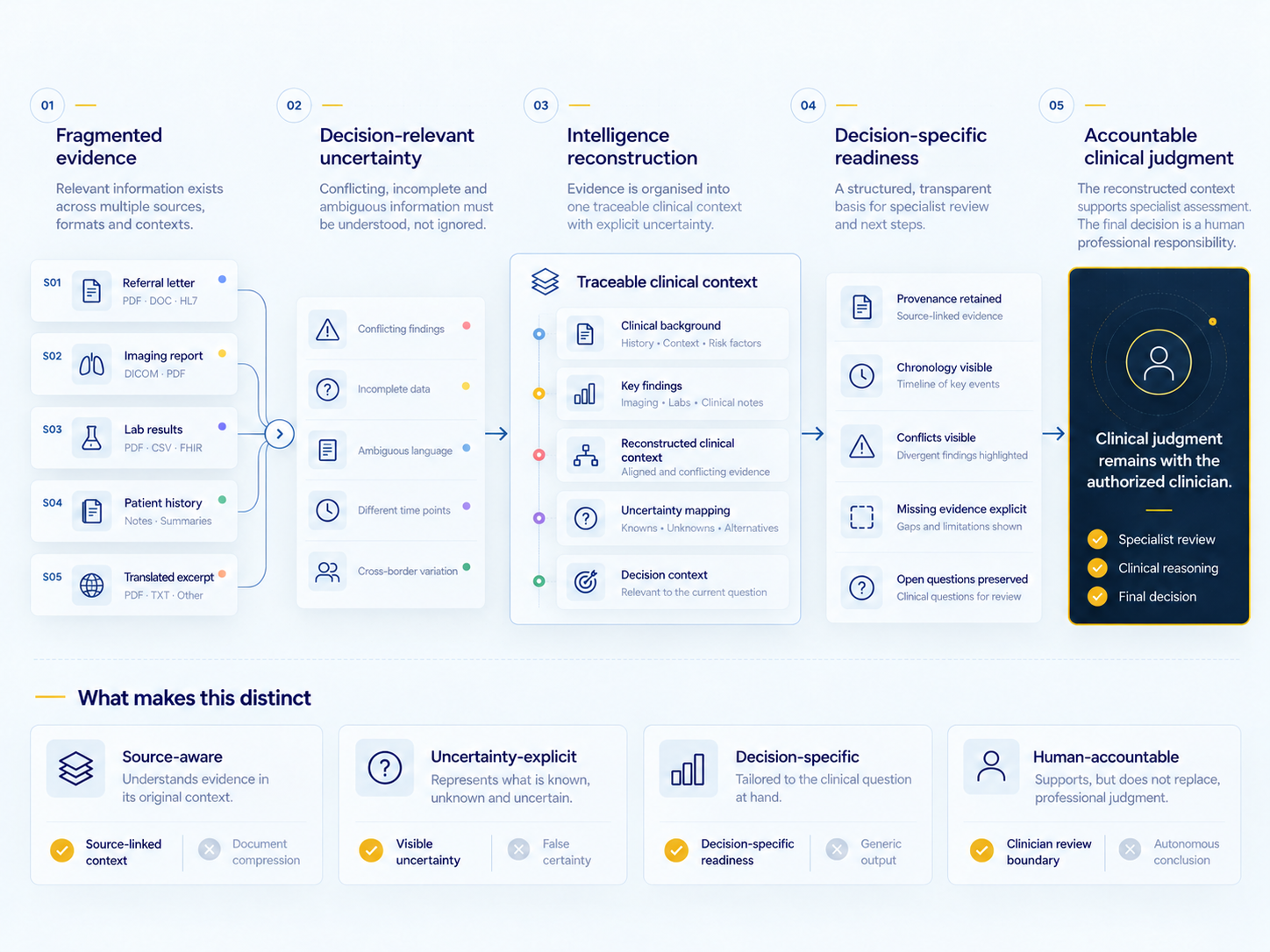
This visual describes a conceptual preparation pathway. Reconstructed context remains distinct from clinician interpretation.
02 / KEY PRINCIPLES
What the preparation must preserve.
Make the evidence
reviewable.
The framework asks what is known, what remains unresolved and what the clinical question still requires.
EVIDENCE PREPARATION / CLINICAL AUTHORITY- 01SOURCE ↔ CONTEXT
Source-linked context
Evidence remains connected to its originating records. Provenance and chronology stay visible.
- 02? / UNRESOLVED
Explicit uncertainty
Missing, conflicting or unresolved information remains visible rather than being silently flattened.
- 03DEFINED QUESTION
Decision alignment
Relevant evidence is reconstructed around the clinical question being reviewed.
- 04OPEN REQUIREMENTS
Decision-specific readiness
The case is organized around what is known, uncertain, missing and still required for review.
- 05CLINICAL AUTHORITY
Clinician review boundary
Interpretation and accountable clinical judgment remain with the authorized clinician.
03 / A DIFFERENT ORIENTATION
A summary compresses records.
Clinical preparation connects them.
Summarization can make documents easier to read. CBCIA focuses on a further question: what does this evidence support, what remains unresolved, and what does the clinical decision still require?
| Review dimension | Document summary focus | CBCIA conceptual orientation |
|---|---|---|
| Source relationships | Compress records into a shorter account; provenance may become detached. | Retain source links, chronology and the original evidence context. |
| Clinical context | Condense document contents; relevant and incidental findings may remain mixed. | Reconstruct relevant evidence around the clinical question. |
| Uncertainty | Compression may flatten conflict, missing information or ambiguity. | Keep conflicts, gaps and unresolved questions explicit. |
| Decision requirements | Provide a general account without specifying what a decision still needs. | Organize what is known, uncertain, missing and still required for review. |
| Clinical authority | A document output may leave the review stage undefined. | Preserve an explicit authorized clinician review boundary. |
04 / RESEARCH & PRODUCT
Related thinking.
Distinct roles.
A framework for the problem.
CBCIA explores evidence reconstruction, decision-specific readiness and accountable clinical judgment. It informs the architecture, product thinking and design of Krinex Clinical.
A practical workflow.
The platform applies these ideas to evidence preparation and clinician review. The conceptual framework and the commercial product are related, but distinct.
Explore Krinex ClinicalCBCIA does not establish clinical validation or prove product effectiveness. It should not be interpreted as scientific proof of clinical performance.
AI assists evidence preparation. Clinical judgment remains with the authorized clinician.
CONTINUE THE CONVERSATION
Discuss the clinical question.
Explore the preparation it requires.
Discuss a clinical workflow or explore how these ideas inform Krinex Clinical.