KRINEX CLINICAL / CLINICAL INTELLIGENCE PLATFORM
From fragmented clinical evidence
to a clearer decision context.
Krinex Clinical reconstructs fragmented clinical evidence into structured, traceable and decision-specific intelligence for clinician review.
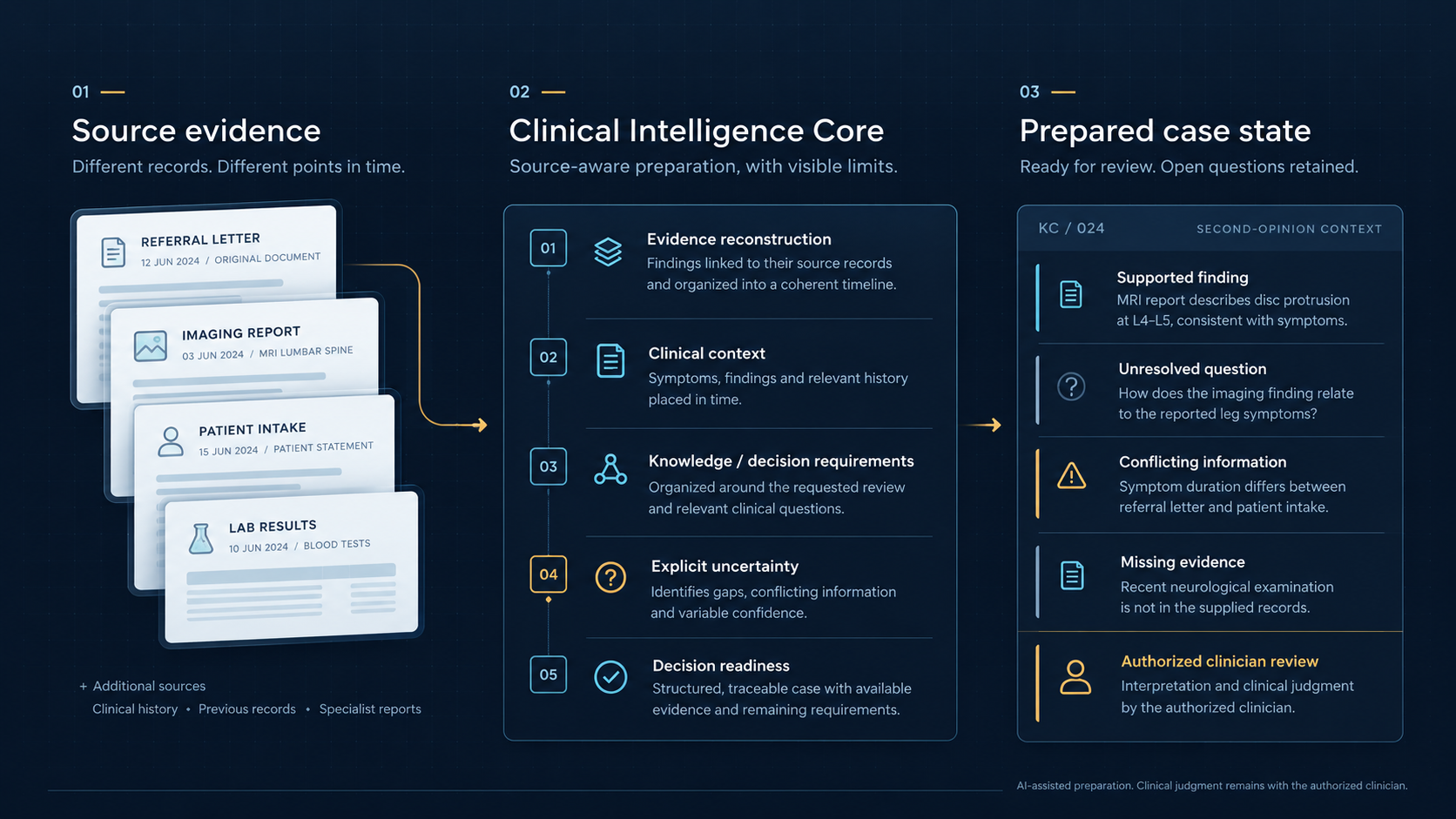
Source evidence
Different records. Different points in time.
+ Additional sources
Clinical history · Previous records · Specialist reports
Clinical Intelligence Core
Source-aware preparation, with visible limits.
- 01
Evidence reconstruction
Findings linked to their source records and organized into a coherent timeline.
- 02
Clinical context
Symptoms, findings and relevant history placed in time.
- 03
Knowledge / decision requirements
Organized around the requested review and relevant clinical questions.
- 04
Explicit uncertainty
Identifies gaps, conflicting information and variable confidence.
- 05
Decision readiness
Structured, traceable case with available evidence and remaining requirements.
Prepared case state
Ready for review. Open questions retained.
Supported finding
MRI report describes disc protrusion at L4–L5, consistent with symptoms.
Unresolved question
How does the imaging finding relate to the reported leg symptoms?
Conflicting information
Symptom duration differs between referral letter and patient intake.
Missing evidence
Recent neurological examination is not in the supplied records.
Authorized clinician review
Interpretation and clinical judgment by the authorized clinician.
AI assists evidence preparation. Clinical judgment remains with the authorized clinician.
02 / THE CORE, IN A CLINICAL CASE
Fragmented records become
a readable clinical picture.
A finding with its sources. A conflict that stays visible.
A missing record that matters to the next decision.
Lumbar spine case review
48-year-old adult · Persistent back and leg symptoms · Records from two care settings
Clinician review pending
Persistent symptoms; reported L4–L5 finding
The referral describes persistent back and right-sided leg symptoms. The MRI report describes an L4–L5 disc protrusion. Their clinical relationship requires clinician assessment.
Referral: approximately 6 months. Patient intake: approximately 18 months. The difference is preserved for clarification.
Traceable preparation, visible limits. AI assists evidence preparation. Missing information and conflicting records remain explicit. Clinical judgment stays with the authorized clinician.
03 / SHARED CORE, DIFFERENT CONTEXTS
The decision changes.
The evidence discipline stays.
Clinical Profiles connect the shared core to the requirements of a particular care context.
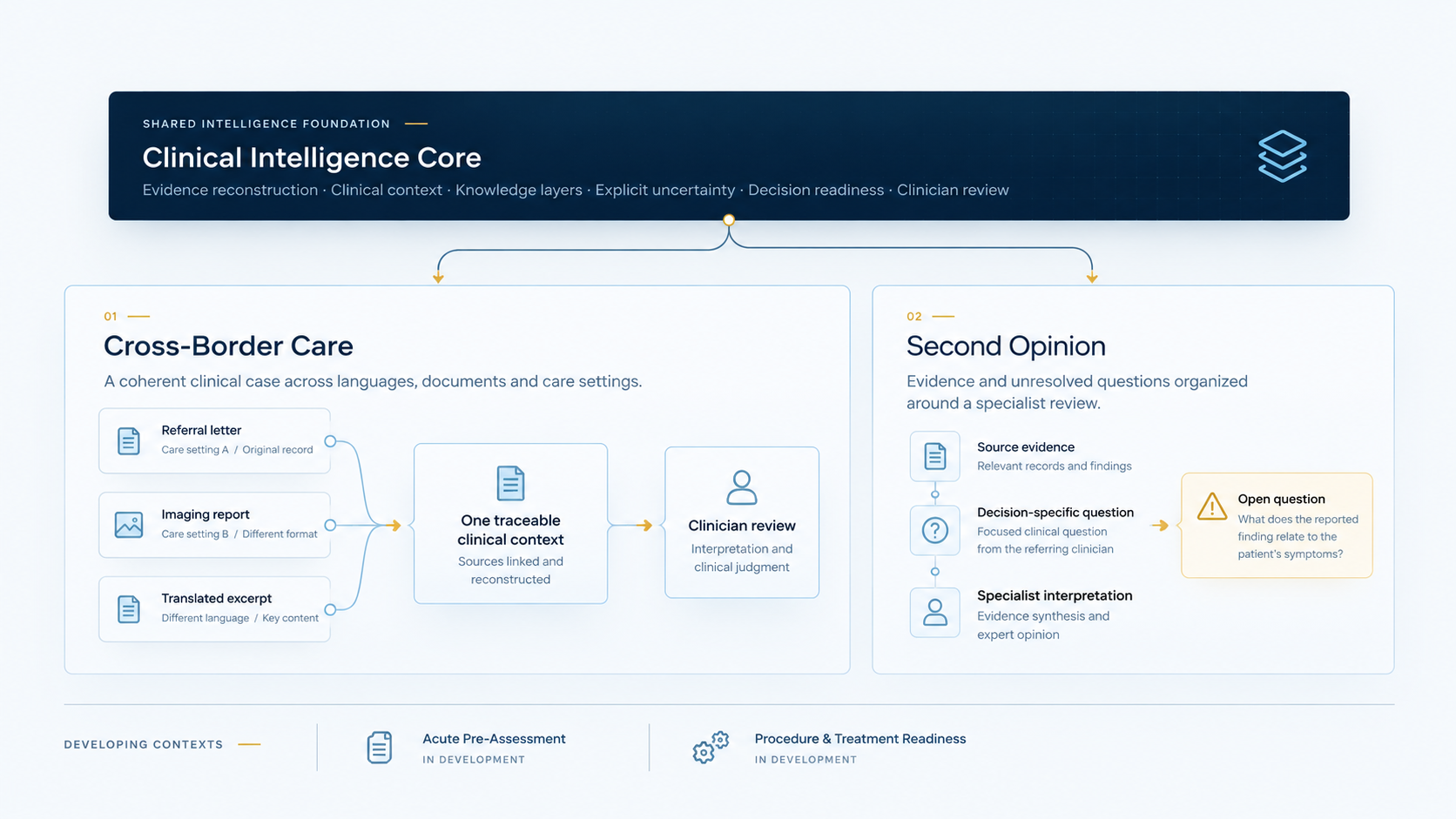
Clinical Intelligence Core
- Evidence reconstruction
- Clinical context
- Knowledge layers
- Explicit uncertainty
- Decision readiness
- Clinician review
Cross-Border Care
CURRENT PROFILEA coherent clinical case across languages, documents and care settings.
- S01Referral letterCare setting A · Original record
- S02Imaging reportCare setting B · Different format
- S03Translated excerptDifferent language · Key content
One traceable clinical context
Sources linked and reconstructed.
Clinician review
Interpretation and clinical judgment remain with the authorized clinician.
Second Opinion
EXPANDING USE CASEEvidence and unresolved questions organized around a specialist review.
- Source evidenceRelevant records and findings
- Decision-specific questionFocused clinical question from the referring clinician
- Specialist interpretationEvidence synthesis and expert opinion
How does the reported finding relate to the patient’s symptoms?
04 / INTELLIGENCE WITH BOUNDARIES
Evidence is prepared.
Clinical authority is preserved.
AI assists evidence preparation.
Clinical judgment remains with the authorized clinician.
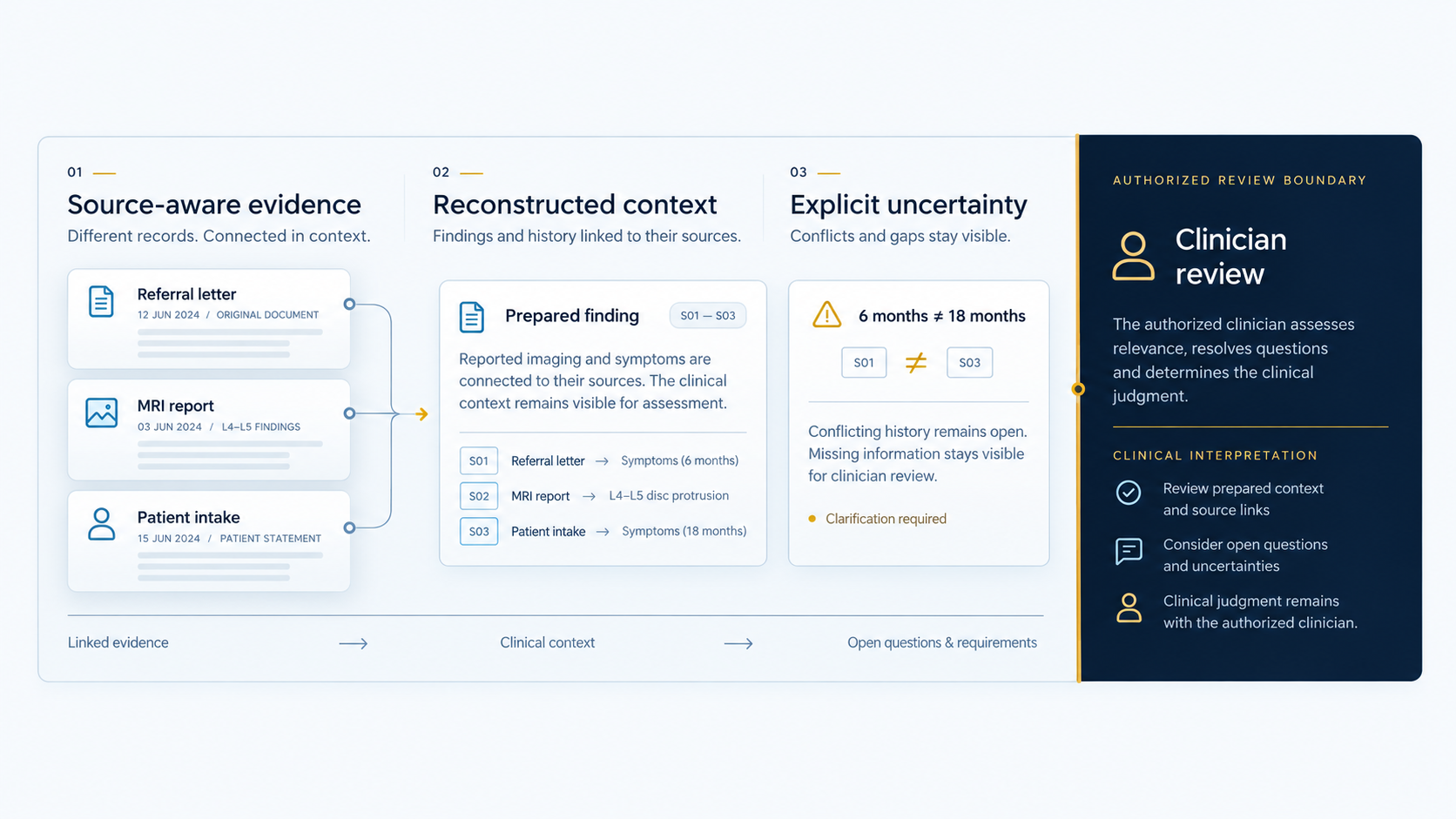
Different records. Connected in context.
- S01Referral letter12 JUN 2024 · Original document
- S02MRI report03 JUN 2024 · L4–L5 findings
- S03Patient intake15 JUN 2024 · Patient statement
02 / Reconstructed clinical context
Reported imaging and symptoms are connected to their sources. The clinical context remains visible for assessment.
- S01 · Referral letterSymptoms: 6 months
- S02 · MRI reportL4–L5 disc protrusion
- S03 · Patient intakeSymptoms: 18 months
6 months ≠ 18 months
S01 ≠ S03 · Clarification required
Conflicting history remains open. Missing information stays visible for clinician review.
Clinician review
Interpretation and clinical judgment remain with the authorized clinician.
- Review prepared context and source links
- Consider open questions and uncertainties
05 / FOR ORGANIZATIONS
Different care settings.
The same need for clinical clarity.
Where fragmented records create preparation work, Krinex helps organize the evidence for clinician review.
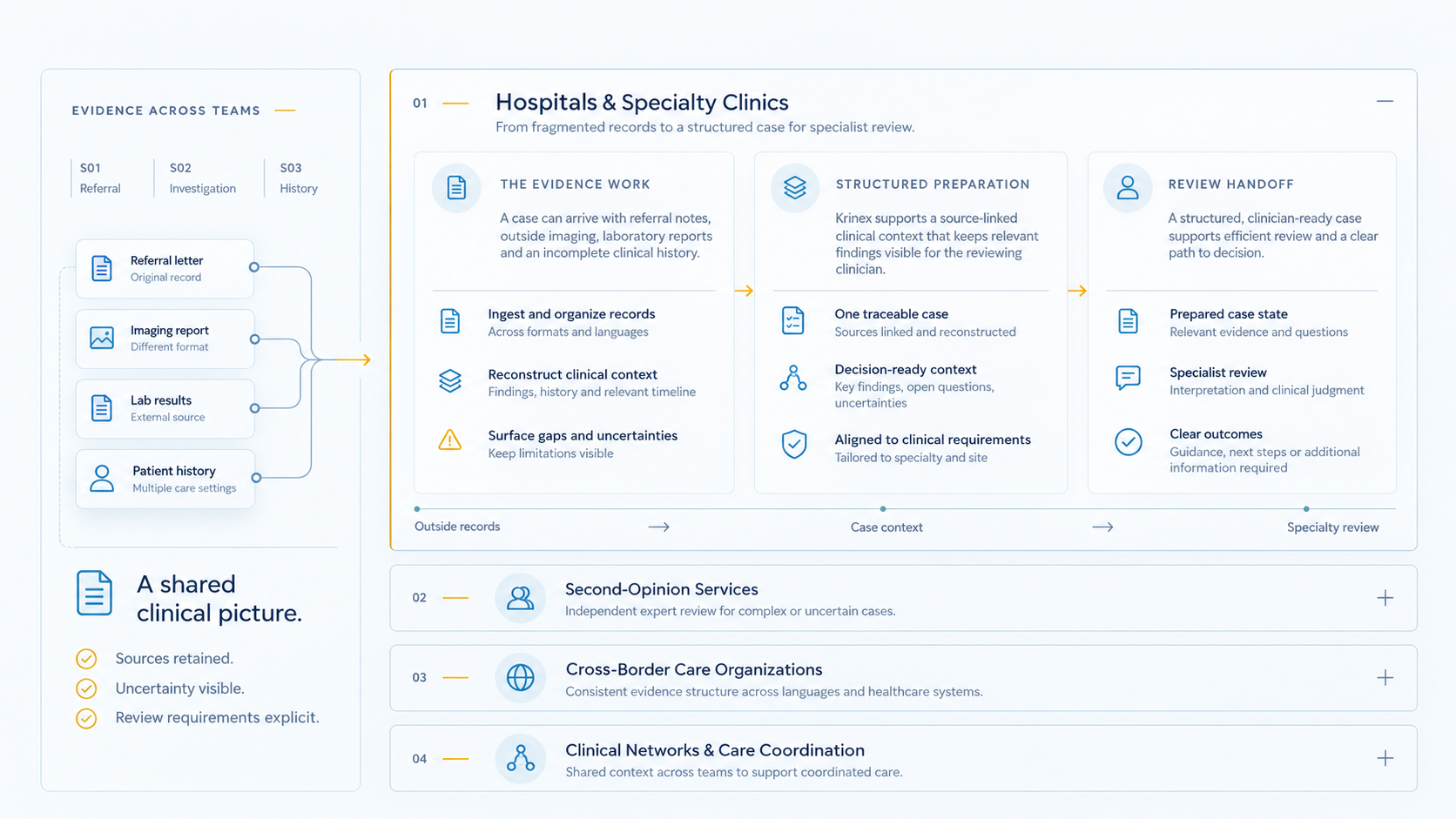
- S01Referral letterOriginal record
- S02Imaging reportDifferent format
- S03Lab resultsExternal source
- Patient historyMultiple care settings
A shared clinical picture.
Sources retained. Uncertainty visible. Review requirements explicit.
Hospitals & Specialty Clinics
From fragmented records to a structured case for specialist review.
The evidence work
A case can arrive with referral notes, outside imaging, laboratory reports and an incomplete clinical history.
- Ingest and organize recordsAcross formats and languages
- Reconstruct clinical contextFindings, history and relevant timeline
- Surface gaps and uncertaintiesKeep limitations visible
Structured preparation
Krinex supports a source-linked clinical context that keeps relevant findings visible for the reviewing clinician.
- One traceable caseSources linked and reconstructed
- Decision-ready contextKey findings, open questions, uncertainties
- Aligned to clinical requirementsTailored to specialty and site
Clinician review
Interpretation and clinical judgment remain with the authorized clinician.
- Prepared case stateRelevant evidence and questions
- Specialist reviewInterpretation and clinical judgment
- Clear outcomesGuidance, next steps or additional information required
- Second-Opinion ServicesIndependent expert review for complex or uncertain cases.
- Cross-Border Care OrganizationsConsistent evidence structure across languages and health systems.
- Clinical Networks & Care CoordinationShared context across teams to support coordinated care.
Explore organizational contexts
01Hospitals & Specialty Clinics
THE EVIDENCE WORKA case can arrive with referral notes, outside imaging, laboratory reports and an incomplete clinical history. Reconstructing the context adds preparation work before review.
STRUCTURED PREPARATIONKrinex supports a source-linked clinical context that keeps relevant findings, conflicts and missing records visible for the reviewing clinician.
02Second-Opinion Services
THE EVIDENCE WORKThe original opinion, investigation reports and patient account may describe different aspects of the same case. The specialist needs to see what is supported and what still needs clarification.
STRUCTURED PREPARATIONKrinex supports structured evidence preparation around the requested clinical question, preserving provenance and unresolved uncertainty for specialist review.
03Cross-Border Care Organizations
THE EVIDENCE WORKRecords can span languages, care settings and points in time. Transferring documents alone does not give the receiving clinician a coherent case context.
STRUCTURED PREPARATIONKrinex supports reconstruction across those sources, with traceable findings, visible information gaps and explicit requirements for clinician review.
04Clinical Networks & Care Coordination
THE EVIDENCE WORKA case may move between teams with clinical information distributed across reports, updates and previous assessments. Each handoff can require the context to be rebuilt.
STRUCTURED PREPARATIONKrinex supports a shared, source-aware preparation view so the reviewing team can identify the available evidence, open questions and information still required.
06 / RESEARCH FOUNDATION
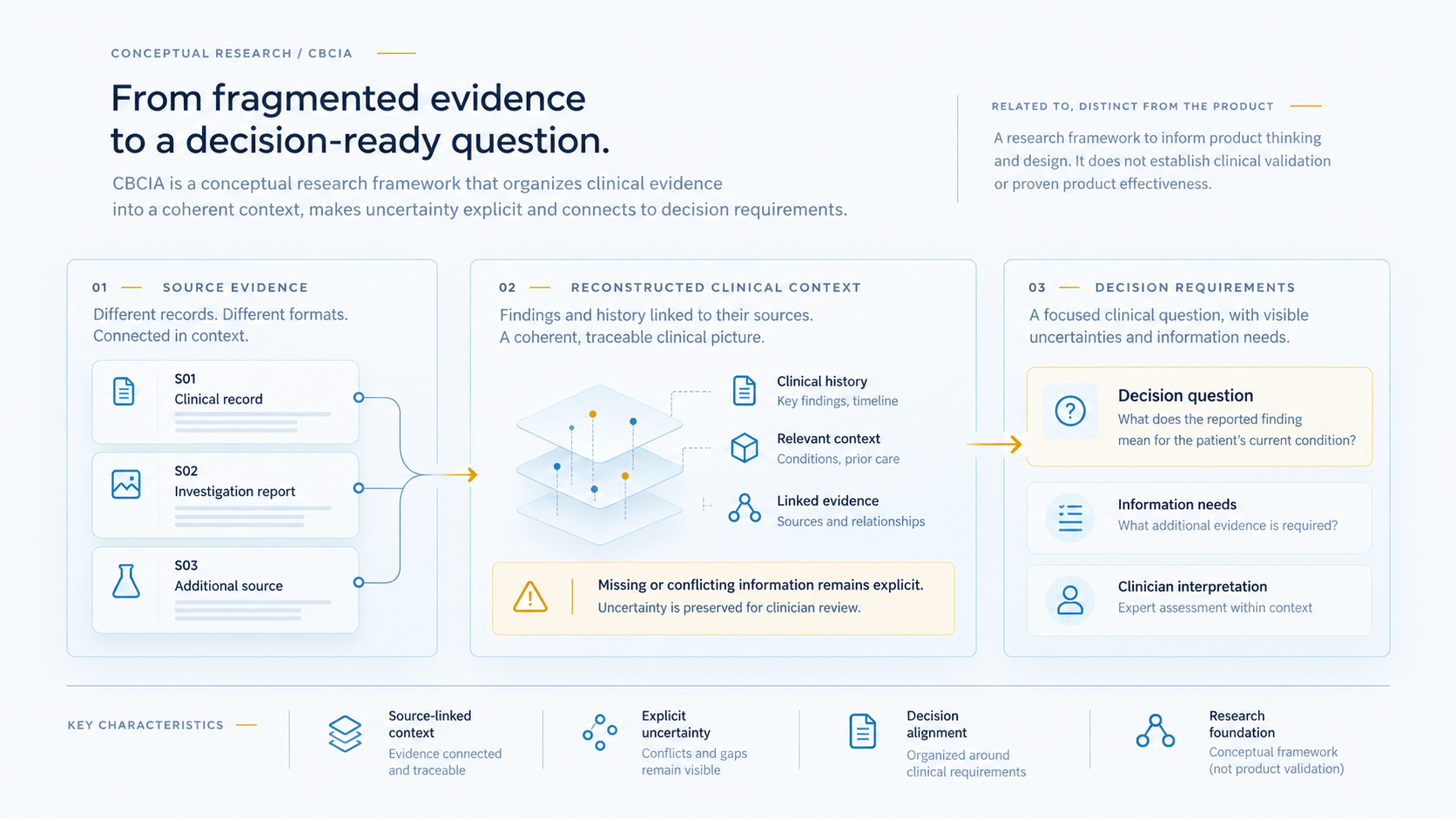
From fragmented evidence to a decision-ready question.
CBCIA is a conceptual research framework that organizes clinical evidence into a coherent context, makes uncertainty explicit and connects to decision requirements.
01 / Source evidence
Different records. Different formats. Connected in context.
- S01Clinical recordSource-linked context
- S02Investigation reportEvidence connected and traceable
- S03Additional sourceSources and relationships
02 / Reconstructed clinical context
Findings and history linked to their sources. A coherent, traceable clinical picture.
- Clinical historyKey findings, timeline
- Relevant contextConditions, prior care
- Linked evidenceSources and relationships
Missing or conflicting information remains explicit. Uncertainty is preserved for clinician review.
03 / Decision requirements
A focused clinical question, with visible uncertainties and information needs.
- Decision questionWhat does the reported finding mean for the patient’s current condition?
- Information needsWhat additional evidence is required?
Clinician review
Interpretation and clinical judgment remain with the authorized clinician.
Expert assessment within context.
A research framework to inform product thinking and design. It does not establish clinical validation or proven product effectiveness.